
Apply

Master of Information Technology

Our Master of IT is industry-focused and prepares students for employment or career progression through a combination of technical and leadership skills.

Course Overview

Qualification Info

Award
Masters
Degree

AQF Level
Level 9

AQF Logo

Study Method

In class face to face


Entry Requirements


Duration

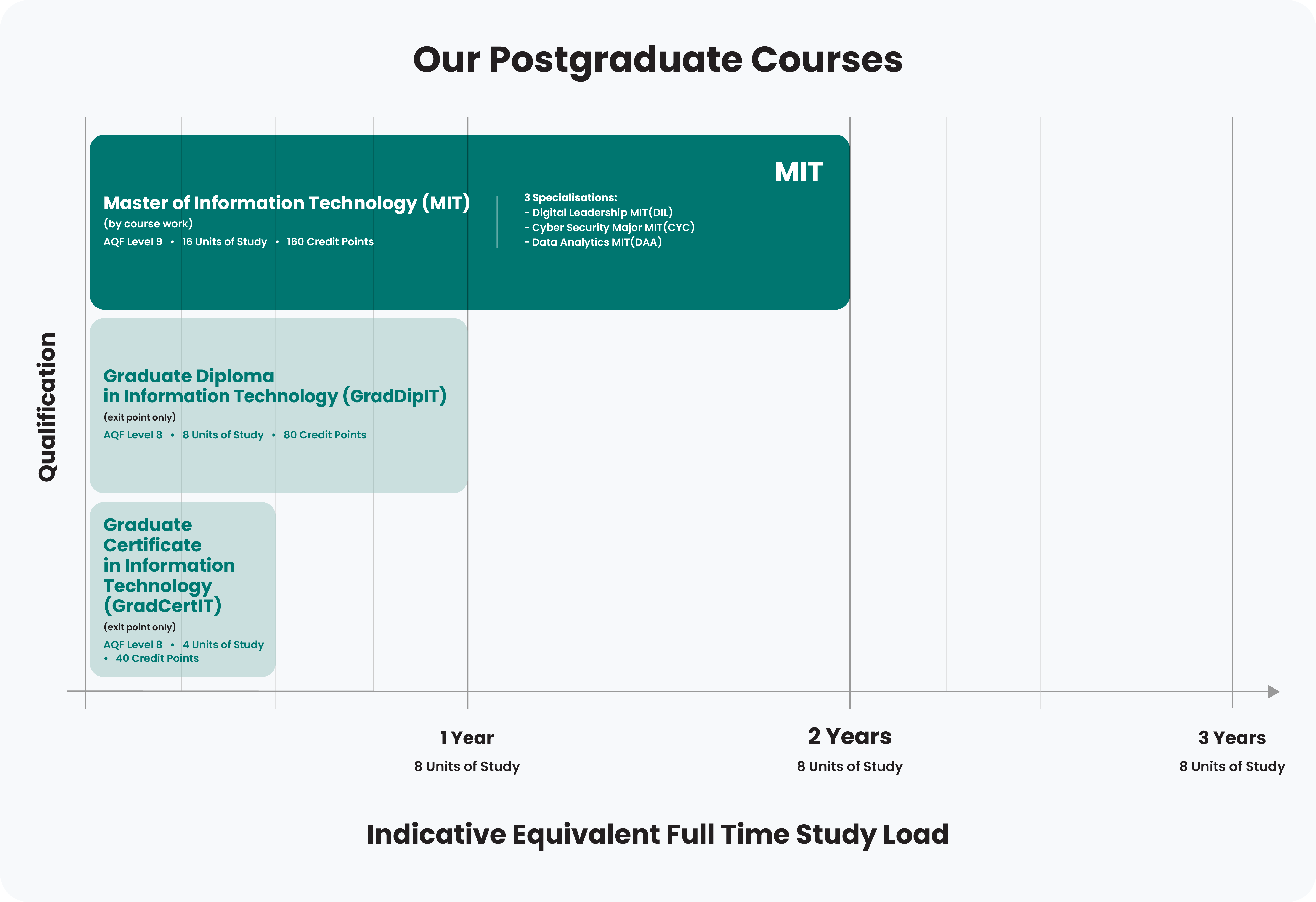
2 Years


Credit Points

160 credit points

(Each unit is worth 10 credit points).


Unit Summary

16 Units

  • 7 Core ICT Units
  • 2 Core/Professional Skills Units
  • 3 Elective Unit choices from 8 units (across all 3 specialisations)
  • 4 Core Specialisation Units: Data Analytics or Cyber Security or Digital Leadership

Course Structure


Potential Job Opportunities


Important Enrolment Dates


The Master of Information Technology (109070C) is accredited by Australian Computer Society (ACS) to meet ACS and international Seoul Accord graduate standards.


CRICOS Course Codes

  • Master of Information Technology (109070C)
  • Graduate Diploma in Information Technology (109071B)
  • Graduate Certificate in Information Technology (109071B)

About this Course

Industry-focused
Our Master of IT is industry-focused and prepares students for employment or career progression through a combination of technical and leadership skills. The course is designed to meet the career needs and aspirations of IT professionals, whether they want to pursue a career in specialist IT technologies, cyber security, data analytics, business systems, or IT leadership and management. The Master’s program includes a strong focus on building the leadership and integration skills which support the strategic application of IT technologies.

Flexible
We also recognise that today’s business professionals may want a career change into the IT field. Our Master’s course is designed to facilitate such a career transition. SISTC also offers multiple entry and exit points so that students can progressively build their qualifications profile.

Options
We offer three specialisations in the Master’s program. These are specifically designed to allow students to choose units of study which prepare them effectively for their career choice.

Master of Information Technology


Course Diagram

Our Graduate Attributes

Our graduate attributes represent the graduate qualities and skills our students may develop throughout their course of study.

  1. Demonstrate comprehensive knowledge and skills in their chosen discipline and apply them in relevant professional contexts.
  2. Demonstrate the capacity to be innovative, entrepreneurial, and take on leadership roles in their chosen career.
  3. Communicate effectively to culturally diverse professional audiences across multiple platforms to achieve common goals.
  4. Solve problems independently and as part of a team by applying research methodologies, critical, creative, and evidence-based thinking to provide innovative responses to existing and future challenges and to solve real-world problems.
  5. Act with professional integrity and promote ethical practice in work and business.
  6. Display resilience, reflexivity, and self-awareness and respond appropriately in a range of professional contexts including new environments and issues.
Course Learning Outcomes
  • Demonstrate appropriate knowledge and understanding of ICT infrastructure technologies and explain the relationships and interdependencies between these. (ACSGA2)
  • Skill and ability to identify the need for transformative digital solutions, especially those relating to provision of ICT systems and infrastructure, elicit requirements from relevant stakeholders and research and plan solutions to meet these requirements. (GA1, GA5, ACSGA1, ACSGA3)
  • Demonstrate problem-solving skills to apply contemporary technologies to previously unseen problems in innovative ways when implementing, maintaining, documenting, and troubleshooting systems. (GA3, GA5, ACSGA1, ACSGA3, ACSGA4)
  • Assess and analyse the appropriateness of competing methodologies and technologies for the analysis, design, and implementation of ICT solutions, including consideration of alternative approaches to enterprise architecture and ICT procurement. (ACSGA1, ACSGA3, ACSGA4)
  • Plan and deploy secure network systems utilising current practices in IP technologies, network security, and scalable server deployment, considering issues of virtualisation and cloud deployment. (ACSGA2)
  • Communicate effectively in English in a professional context, adapt interaction style to a given audience, work efficiently in a team, and identify and address pertinent legal, social, and ethical issues in particular ICT contexts. (GA2, GA4, ACSGA3)
  • Offer computer support services to individuals and small to medium sized enterprises, as well as becoming employed as a computer services professional in an organisation. (GA1, ACSGA1).

Course Units
Master of Information Technology

First Year

First Year
  • ICT501
    Foundations of IT

    This unit introduces the fundamental knowledge and skills needed to use information and communications technologies (ICT) effectively. It covers the Information Technology (IT) architectural building blocks which include hardware, software and network, databases, and security elements that are necessary to deliver seamless and ethically informed IT services.

  • ICT502
    Internet and Web Development

    The advent of the internet and the World Wide Web have contributed to significant changes in the way society and businesses engage in this digital world. The world wide web leverages off the internet to enable people to connect, collaborate, and coordinate across different time zones so they can increase business productivity and growth.

  • ICT503
    Database Management Systems

    This unit provides students with a detailed conceptual and practical introduction to the use of common platforms that manage the relational databases. Students will develop an understanding of the foundations of database modelling and database management and will have the opportunity to enhance their theoretical and practical knowledge of widespread relational database systems.

  • ICT504
    IT Project Management

    This unit explores the fundamentals and the advanced theories and concepts that underpin IT project management frameworks and tools. It provides students with the opportunity to apply and evaluate the technical and soft concepts relating to the Project Management Body of Knowledge (PMBOK) and Agile project management that enable the delivery of information technology solutions in the form of products, services, and improvements that maintain organisational competitiveness.

  • ICT505
    Fundamentals of Data Analytics

    Data analytics focuses on transforming large amounts of data into meaningful and commercially important information. It encompasses a variety of IT areas that include statistical methods for finding patterns in data and inferring conclusions; database technologies for managing the data sets to be mined; a variety of advanced systems that derive patterns from data automatically; and visualisation and other multimedia methodologies that aid human pattern discovery abilities.

  • ICT506
    Cyber Security

    This unit introduces students to real-world cyber security issues faced by the community and by industry. An overview of professional, legal, and ethical issues related to the security of computer systems which are of significant concern in contemporary society is provided.

  • ICT507
    Cloud Computing

    This unit will provide students with a comprehensive study of the principles, strengths, and limitations of Cloud Computing. Various cloud service and deployment models will be discussed in detail in this unit.

  • ICT508
    Management Information Systems
    Choice of First Year Elective

    ICT508 focuses on the crucial role of information systems in the global business arena, highlighting their significance in fostering stakeholder collaboration, enabling knowledge creation, and improving decision-making to maintain competitiveness. ICT508 addresses strategic investment in line with organisational goals, the use of advanced technologies for operational efficiency, and the ethical, social, and security challenges posed by information systems. Students will learn to identify strategic opportunities, analyse cases, apply theories, and formulate information systems strategies, while also tackling ethical issues and barriers for effective knowledge management and decision-making.

  • ICT509
    Object-Oriented Programming
    Choice of First Year Elective

    ICT509 course, “Object-Oriented Programming with Python,” aims to equip students with a solid foundation in object-oriented programming (OOP) concepts and their practical applications in Python. Throughout the 12-week course, students will progress from basic to advanced OOP principles, gaining proficiency in designing, developing, and deploying Python applications. The course is structured to blend theoretical knowledge with practical exercises, preparing students for roles such as Senior Python Developer. By the end of the course, students will have developed a portfolio of projects demonstrating their expertise in Python and OOP.

  • BUS502
    Accounting for Decision Making
    Choice of First Year Elective

    BUS502 Accounting for Decision Making equips aspiring managers with the essential skills to incorporate financial and non-financial data into their decision-making processes. It addresses the knowledge gap that many graduates face by providing them with the ability to identify, acquire, manipulate, and analyse data for informed business decisions. Students will learn cost analysis, financial reporting interpretation, spreadsheet modelling, systems thinking, cost-benefit analysis, and psychological factors influencing decision-making. By completing BUS502, students will develop financial literacy and the ability to make impactful decisions in their managerial roles.

A subject you can choose to study during your first year, based on your interests.


Second Year

Cyber Security (MIT Specialisation)
  • ICT611
    Ethical Hacking and Penetration Testing

    This unit provides a comprehensive study of principles, procedures, and methodologies that are currently used to carry out ethical hacking and the penetration testing (pentesting) of an Information Technology (IT) system with the consent of its owner to verify the weakness and vulnerabilities of the system. This unit will provide students with the knowledge and skills to conduct ethical hacking and pentesting in a systematic way by using different open-source tools and techniques. In addition, this unit will cover the legal and ethical challenges related to ethical hacking and pentesting in detail.

  • ICT612
    Cloud Security and Privacy

    Cloud computing is widely used these days because of it offers on-demand resources and pay-asyougo model to individuals and corporate end-users. However, cloud suffers from various security and privacy issues.

  • ICT613
    Digital Forensics

    This unit provides a comprehensive study of principles, procedures, and methodologies that are currently used to carry out Digital Forensics As network breaches and digital crimes become more common in the digital landscape, the need for cyber forensics investigators is growing rapidly. This unit prepare students with the knowledge and skills required to conduct a digital investigation in an organised and systematic way.

  • ICT614
    Cyber Security Law and Policy

    This unit introduces the cybersecurity laws, policies, legal frameworks, and standards that are used in the IT profession and businesses both in Australia and globally. In this unit, cybersecurity threats that involve the use of a computer or online network to commit crimes such as fraud, identity theft, or threats and intimidation are discussed.

  • ICT651
    IT Research Methods

    This unit sets out to help students design and develop their research projects from inception to completion. It does this by synthesising rigorous coverage of methodologies with an accessible “real-world” approach.

  • ICT652
    Leadership and Innovation in IT
    Choice of Second Year Elective

    ICT652 explores the changing role of IT systems and evaluates the shift from being the enablers of change to being the drivers of innovation and change within industries. ICT652 focuses on the implications of this change for IT leadership within a globalised 21st century world of rapid and accelerating technological innovation. In this context, ICT652 examines the importance of organisational systems including governance, technical, human, and ethical systems in building a sustainable innovation capacity within organisations. Students will have the opportunity to apply their unit learnings to address a range of practical innovation challenges at a strategic and operational level. Through practical activities, students will develop appropriate approaches to innovation and will also develop an understanding of the concepts and skills that are required to build consensus for and commitment to change. In ICT652, students critically reflect on various leadership styles and strategies, equipping them with insights and tools necessary to thrive as leaders in the dynamic field of IT.

  • ICT653
    Emerging Technologies in IT
    Choice of Second Year Elective

    The adoption and diffusion of information technology in business has increased exponentially in recent times. ICT653 introduces students to a range of cutting-edge technologies and focuses on discussing their business opportunities. ICT653 introduces machine learning and artificial intelligence, as well as business innovations adopting these technologies. Students will also explore Internet of Things (IoT) architecture, which comprises devices, networks, storage options, platforms, and applications, along with the corresponding management and security components. Furthermore, students will learn about Cloud Computing, Edge Computing, Blockchain, Robotics, and their potential. ICT653 will address emerging technologies and future directions and will also assess the impact of these developments on key areas such as ethics and privacy.

  • ICT655
    Mobile Application Development
    Choice of Second Year Elective

    ICT655 introduces students to a range of technologies and methodologies for developing modern web-based systems and mobile applications, fostering fluency in their strategic application. The course covers topics such as Ajax, client-side and server-side frameworks, aimed at reinforcing key concepts while ensuring data integrity and user confidentiality. Through practical exercises, students will enhance their coding skills with JavaScript and PHP, incorporating best practices for secure coding and data handling. The course also explores contemporary software technologies for mobile application development (Web, Native, and Hybrid) and mobile-friendly web app requirements, with a focus on implementing robust security measures and privacy protections. Students will design and build simple mobile apps using cross-platform frameworks, equipping them with essential skills for the evolving tech landscape while prioritizing the safeguarding of user information.

  • ICT656
    Artificial Intelligence and Blockchain
    Choice of Second Year Elective

    The ICT656 Artificial Intelligence and Blockchain unit provides an in-depth exploration of two transformative technologies: Artificial Intelligence (AI) and Blockchain. This unit equips students with the knowledge and practical skills needed to navigate and innovate in the ever-evolving landscape of AI and Blockchain. Students will gain a solid grasp of the core principles underpinning both AI and Blockchain, learn how these technologies are applied across diverse industries, and explore the symbiotic relationship between them. Ethical considerations and innovative applications will be emphasized, empowering students to contribute to the tech-driven future with creativity and informed decision-making. Through lectures, practical exercises, and assessments, students will emerge well-prepared to make significant contributions to the evolving field of AI and Blockchain.

  • ICT654
    IT Capstone Project

    This unit will give students an opportunity to work on an Information Technology (IT) or Information Systems (IS) related business problem and to develop a research-informed solution. During this unit, students, working with an external client in a real-world context, will have the opportunity to develop a project or provide recommendations for improvements to an existing process.

A choice of two subjects to study during your second year, based on your interests.

Data Analytics (MIT Specialisation)
  • ICT621
    Big Data

    This unit introduces the core concepts and technologies involved in handling and processing Big Data. In recent years, due to enormous growth of internet technologies, there has been a massive surge in both the amount and types of data available to organisations.

  • ICT622
    Data Mining

    This unit covers the fundamental concepts of data mining. It will focus on methods, techniques, and tools to collect, integrate, pre-process, and process large amounts of data to find anomalies, trends, correlations, and patterns in different datasets.

  • ICT623
    Data Visualisation

    This unit covers the fundamental concepts, tools and techniques associated with data visualisation. The unit focuses on solving data interpretation and storytelling problems. It will cover topics on data abstraction, task abstraction, marks and channels, arranging different data, and view manipulations.

  • ICT624
    Advanced Data Analytics

    This unit focuses on advanced statistical and machine learning techniques to perform supervised and unsupervised learning. In addition, other advanced techniques, such as ensemble learning methods, boosting, deep learning, cognitive computing, knowledge systems, and anomaly detection techniques are also discussed in this unit.

  • ICT651
    IT Research Methods

    This unit sets out to help students design and develop their research projects from inception to completion. It does this by synthesising rigorous coverage of methodologies with an accessible “real-world” approach.

  • ICT652
    Leadership and Innovation in IT
    Choice of Second Year Elective

    ICT652 explores the changing role of IT systems and evaluates the shift from being the enablers of change to being the drivers of innovation and change within industries. ICT652 focuses on the implications of this change for IT leadership within a globalised 21st century world of rapid and accelerating technological innovation. In this context, ICT652 examines the importance of organisational systems including governance, technical, human, and ethical systems in building a sustainable innovation capacity within organisations. Students will have the opportunity to apply their unit learnings to address a range of practical innovation challenges at a strategic and operational level. Through practical activities, students will develop appropriate approaches to innovation and will also develop an understanding of the concepts and skills that are required to build consensus for and commitment to change. In ICT652, students critically reflect on various leadership styles and strategies, equipping them with insights and tools necessary to thrive as leaders in the dynamic field of IT.

  • ICT653
    Emerging Technologies in IT
    Choice of Second Year Elective

    The adoption and diffusion of information technology in business has increased exponentially in recent times. ICT653 introduces students to a range of cutting-edge technologies and focuses on discussing their business opportunities. ICT653 introduces machine learning and artificial intelligence, as well as business innovations adopting these technologies. Students will also explore Internet of Things (IoT) architecture, which comprises devices, networks, storage options, platforms, and applications, along with the corresponding management and security components. Furthermore, students will learn about Cloud Computing, Edge Computing, Blockchain, Robotics, and their potential. ICT653 will address emerging technologies and future directions and will also assess the impact of these developments on key areas such as ethics and privacy.

  • ICT655
    Mobile Application Development
    Choice of Second Year Elective

    ICT655 introduces students to a range of technologies and methodologies for developing modern web-based systems and mobile applications, fostering fluency in their strategic application. The course covers topics such as Ajax, client-side and server-side frameworks, aimed at reinforcing key concepts while ensuring data integrity and user confidentiality. Through practical exercises, students will enhance their coding skills with JavaScript and PHP, incorporating best practices for secure coding and data handling. The course also explores contemporary software technologies for mobile application development (Web, Native, and Hybrid) and mobile-friendly web app requirements, with a focus on implementing robust security measures and privacy protections. Students will design and build simple mobile apps using cross-platform frameworks, equipping them with essential skills for the evolving tech landscape while prioritizing the safeguarding of user information.

  • ICT656
    Artificial Intelligence and Blockchain
    Choice of Second Year Elective

    The ICT656 Artificial Intelligence and Blockchain unit provides an in-depth exploration of two transformative technologies: Artificial Intelligence (AI) and Blockchain. This unit equips students with the knowledge and practical skills needed to navigate and innovate in the ever-evolving landscape of AI and Blockchain. Students will gain a solid grasp of the core principles underpinning both AI and Blockchain, learn how these technologies are applied across diverse industries, and explore the symbiotic relationship between them. Ethical considerations and innovative applications will be emphasized, empowering students to contribute to the tech-driven future with creativity and informed decision-making. Through lectures, practical exercises, and assessments, students will emerge well-prepared to make significant contributions to the evolving field of AI and Blockchain.

  • ICT654
    IT Capstone Project

    This unit will give students an opportunity to work on an Information Technology (IT) or Information Systems (IS) related business problem and to develop a research-informed solution. During this unit, students, working with an external client in a real-world context, will have the opportunity to develop a project or provide recommendations for improvements to an existing process.

A choice of two subjects to study during your second year, based on your interests.

Digital Leadership (MIT Specialisation)
  • ICT601
    Enterprise Architecture and Governance

    This unit explores the practice of effective enterprise architecture and governance to deliver humancentred outcomes that align business and technology strategy. The unit also explores the execution of roadmaps and the delivery of strategic objectives to achieve the business vision.

  • ICT602
    Data Management and Decision Making

    This unit discusses the key areas of data management including database development, data quality and corporate data modelling. The unit also discussed how effective data management is vital for organisation’s success as it aids in the decision-making process.

  • ICT603
    Enterprise Systems and System Integration

    This unit introduces the basics of enterprise systems and how to implement enterprise systems for success in organisations. This unit discusses the components of an Enterprise Resource Planning (ERP) system, and the process of implementing ERP systems to increase the overall success of the organisation.

  • ICT604
    Digital Transformation and Sustainability

    This unit introduces students to recent technology innovations in business and explores how digital technology adoption is playing an important part in disrupting traditional businesses or services through digitisation and automation. Students will explore the fundamentals of green IT and sustainability, and they will learn how to apply sustainability tools to analyse digital transformation in their professional and community activities.

  • ICT651
    IT Research Methods

    This unit sets out to help students design and develop their research projects from inception to completion. It does this by synthesising rigorous coverage of methodologies with an accessible “real-world” approach.

  • ICT652
    Leadership and Innovation in IT
    Choice of Second Year Elective

    ICT652 explores the changing role of IT systems and evaluates the shift from being the enablers of change to being the drivers of innovation and change within industries. ICT652 focuses on the implications of this change for IT leadership within a globalised 21st century world of rapid and accelerating technological innovation. In this context, ICT652 examines the importance of organisational systems including governance, technical, human, and ethical systems in building a sustainable innovation capacity within organisations. Students will have the opportunity to apply their unit learnings to address a range of practical innovation challenges at a strategic and operational level. Through practical activities, students will develop appropriate approaches to innovation and will also develop an understanding of the concepts and skills that are required to build consensus for and commitment to change. In ICT652, students critically reflect on various leadership styles and strategies, equipping them with insights and tools necessary to thrive as leaders in the dynamic field of IT.

  • ICT653
    Emerging Technologies in IT
    Choice of Second Year Elective

    The adoption and diffusion of information technology in business has increased exponentially in recent times. ICT653 introduces students to a range of cutting-edge technologies and focuses on discussing their business opportunities. ICT653 introduces machine learning and artificial intelligence, as well as business innovations adopting these technologies. Students will also explore Internet of Things (IoT) architecture, which comprises devices, networks, storage options, platforms, and applications, along with the corresponding management and security components. Furthermore, students will learn about Cloud Computing, Edge Computing, Blockchain, Robotics, and their potential. ICT653 will address emerging technologies and future directions and will also assess the impact of these developments on key areas such as ethics and privacy.

  • ICT655
    Mobile Application Development
    Choice of Second Year Elective

    ICT655 introduces students to a range of technologies and methodologies for developing modern web-based systems and mobile applications, fostering fluency in their strategic application. The course covers topics such as Ajax, client-side and server-side frameworks, aimed at reinforcing key concepts while ensuring data integrity and user confidentiality. Through practical exercises, students will enhance their coding skills with JavaScript and PHP, incorporating best practices for secure coding and data handling. The course also explores contemporary software technologies for mobile application development (Web, Native, and Hybrid) and mobile-friendly web app requirements, with a focus on implementing robust security measures and privacy protections. Students will design and build simple mobile apps using cross-platform frameworks, equipping them with essential skills for the evolving tech landscape while prioritizing the safeguarding of user information.

  • ICT656
    Artificial Intelligence and Blockchain
    Choice of Second Year Elective

    The ICT656 Artificial Intelligence and Blockchain unit provides an in-depth exploration of two transformative technologies: Artificial Intelligence (AI) and Blockchain. This unit equips students with the knowledge and practical skills needed to navigate and innovate in the ever-evolving landscape of AI and Blockchain. Students will gain a solid grasp of the core principles underpinning both AI and Blockchain, learn how these technologies are applied across diverse industries, and explore the symbiotic relationship between them. Ethical considerations and innovative applications will be emphasized, empowering students to contribute to the tech-driven future with creativity and informed decision-making. Through lectures, practical exercises, and assessments, students will emerge well-prepared to make significant contributions to the evolving field of AI and Blockchain.

  • ICT654
    IT Capstone Project

    This unit will give students an opportunity to work on an Information Technology (IT) or Information Systems (IS) related business problem and to develop a research-informed solution. During this unit, students, working with an external client in a real-world context, will have the opportunity to develop a project or provide recommendations for improvements to an existing process.

A choice of two subjects to study during your second year, based on your interests.


Entry Requirements

General Admission (MIT)

  • have attained 18 years of age on commencement of studies
  • Australian bachelor’s degree qualifications in a cognate discipline or;
  • International Bachelor qualifications or equivalent in a Cognate discipline listed at https://www.uac.edu.au/future-applicants/postgraduate-applicantsor
  • Relevant Work Experience in a relevant cognate field for a minimum of two years and completed within the last 3 years. Applicants need to demonstrate work experience is relevant to the course, current, and equivalent to the learning outcomes achieved in a bachelor’s degree in the same discipline as the proposed Post Graduate Program. Students provide this evidence in the form of a written reference from their current workplace outlining their current duties and how they are relevant to the master’s program
  • Applicants applying with bachelor’s degrees, or work experience in a non-cognate field need to provide an additional personal written statement outlining how their formal studies and work experience having provided them with sufficient learning as to be able to reach the entry standards.   Such students may be subject to a written examination or interview with the Academic Dean. Students may need to complete appropriate introductory units as determined by the Academic Dean
  • Any credit applications are considered under the SISTC Credit Transfer and Advanced Standing Policy.

International Students

Applicants require:

  • completed 12 months of study in Australia.
  • IELTS Academic: 6.5 with no band less than 6.0; or
  • TOEFL: 575 or better; or
  • TOEFL IBT (International Benchmark Test): 91 or better; or
  • TOEFL CBT (Computer Based Test): 235 or better; or
  • Academic PTE (Pearson Test of English): overall 56 with no less than 50 or better; or
  • Cambridge English: CAE and CPE (from 2015): 176 or better; or
  • General Certificate of Education (GCE): A Levels with a C or better in English; or
  • Kaplan Test of English (KTE): all bands B2 with a result greater than 450 in each band; or
  • Duolingo: overall 115 with no band less than 110; or.

Credit for Recognition of Prior Learning

View our Credit for Recognition of Prior Learning


Fees and Charges

Fees and Charges
Our fees and charges are set periodically by our Board of Directors.

How to Pay
It is easy to pay your fees to Sydney International School of Technology and Commerce. You’ll find various fee payment options when you receive your application to study with us.

Fees and Charges Schedule
View our Fees and Charges Schedule


Orientation and Induction

View our Orientation and Induction Program


Potential Job Opportunities

On completion of the Bachelor of Information Technology, some potential jobs you might consider.

Potential jobs:

  • Web Developer:
    Focused on developing web applications for client-server communication.

  • Cybersecurity Engineer:
    Designs, implements, and maintains security solutions against cyber threats.
  • Penetration Tester (Ethical Hacker):
    Identifies system vulnerabilities for security enhancement.
  • Digital Forensic Analyst:
    Investigates and analyses digital evidence for cybercrime investigations.
  • Data Scientist:
    Extracts insights from large datasets for decision-making.
  • Business Intelligence Analyst:
    Provides actionable insights for business optimisation.
  • Data Engineer:
    Designs and maintains data infrastructure for analytics.
  • Digital Transformation Manager:
    Drives organisational change through digital integration.
  • IT Project Director:
    Oversees large-scale IT projects for organisational success.
  • Enterprise Systems Manager:
    Manages implementation and optimisation of enterprise-level IT systems.
  • Cloud Solutions Architect:
    Designs and implements cloud-based solutions to meet business requirements.
Was this page helpful?
Skip to content